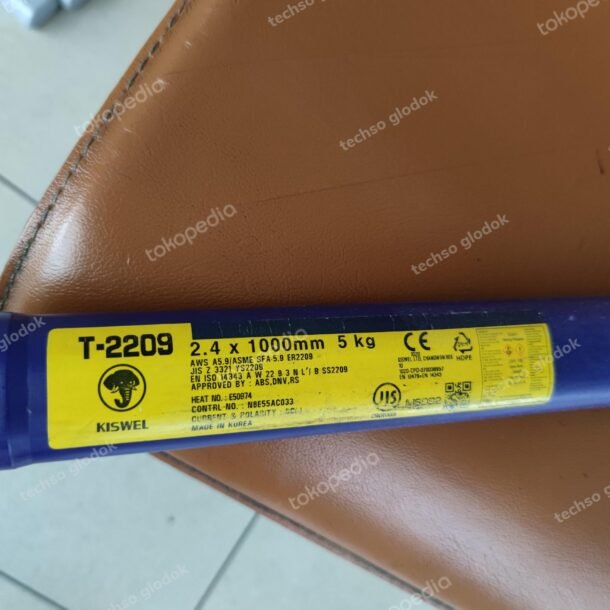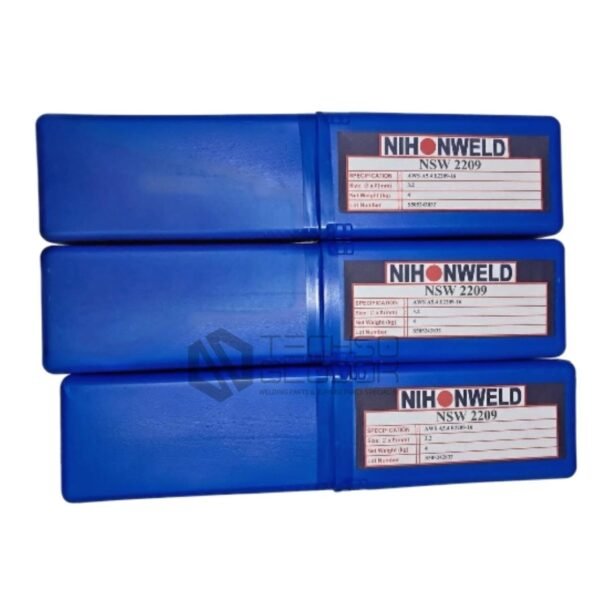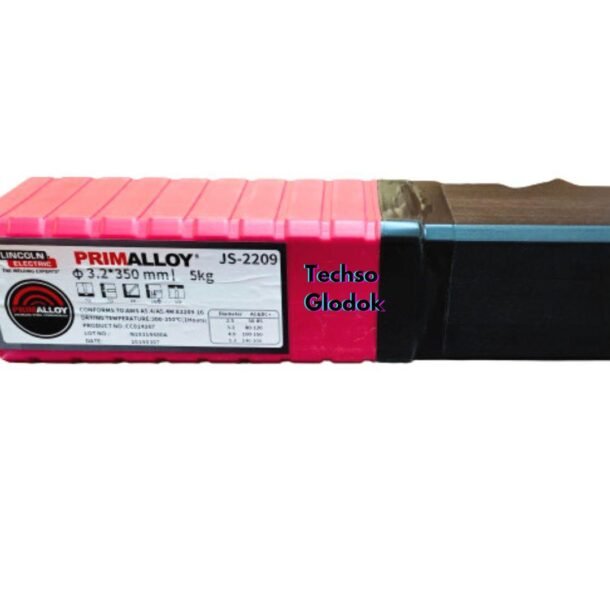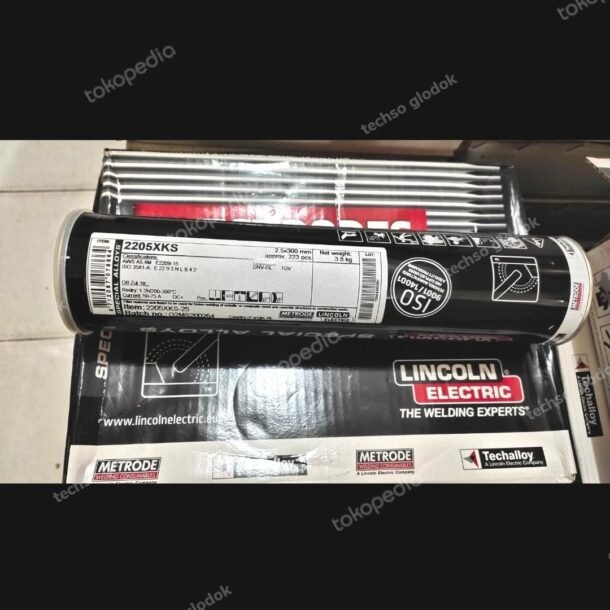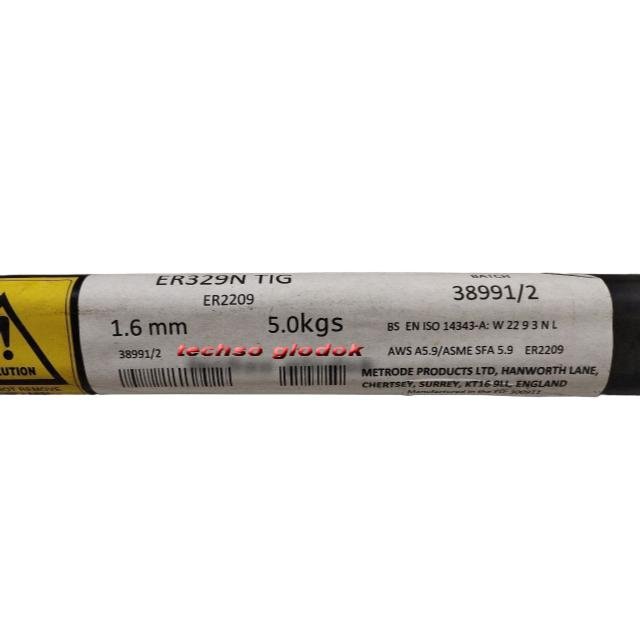
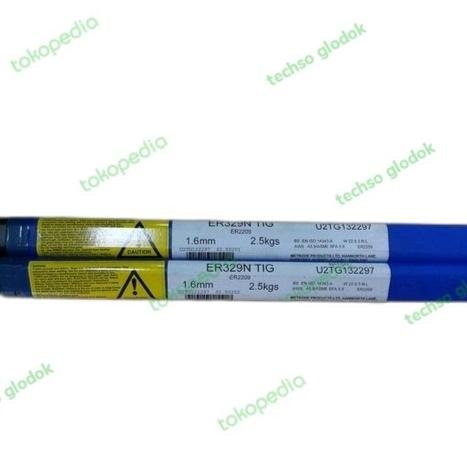

Metrode Tig ER329N
AWS A5.9 ER2209
Dia 1.6x1000mm
Packing Price 5kg/Tube
Duplex stainless steel pipe, plate, fittings and forgings have an approximate 50:50 microstructure of austenite with a ferrite matrix. This, coupled with general alloying level, confers:
– high strength compared with standard austenitic steels, eg type 316L.
– good general corrosion resistance in a range of environments.
– high resistance to chloride induced stress corrosion cracking (CSCC).
– high resistance to pitting attack in chloride environments, eg seawater.
These alloys are finding widening application in the offshore oil/gas, chemical and petrochemical process industries, eg pipework systems, flowlines, risers, manifolds etc.
There is a range of stainless steel alloys with a duplex, ferritic-austenitic, microstructure and this leaflet provides guidance on welding these alloys. Standard duplex is 22%Cr (eg. UNS S31803 and S32205) and superduplex is 25%Cr with a pitting resistance equivalent number (PREN) 40 (eg. UNS S32760, S32750 and S32550).
Duplex and superduplex stainless steels have become firmly established for a number of applications in the offshore sector because of their excellent combination of strength and corrosion resistance. The most commonly used alloys, giving typical properties, are shown, along with 316L for comparison. Standard duplex is 22%Cr (eg. UNS S31803 and S32205) and superduplex is 25%Cr with a pitting resistance equivalent number (PREN) 40 (eg. UNS S32750, S32760 and S32550). This will look at typical code and specification requirements and examine the properties that can be realistically achieved with the various processes; identifying some of the unrealistic requirements imposed by specifications.